Pauline and Pecola’s mother-daughter relationship
The Bluest EyePauline and Pecola’s mother-daughter relationship is marked by a failure of protection and trust that leaves Pecola exposed both at home and in the community. Pauline is not simply absent: she appears in moments when care might be expected, but her response can instead be punitive, and later accounts describe a silence so complete that Pecola seems almost unseen. The contrast makes the relationship consequential beyond private family conflict: it shows how a child’s need for recognition and safety goes unanswered within the household meant to provide them.
Identity and Background
Pauline and Pecola are mother and daughter in the Breedlove family, whose poverty is not presented as a temporary setback. The family lives in a storefront because they are poor and Black, and remains there because they have come to believe themselves ugly. That combination of material deprivation and internalized judgment forms part of the setting in which Pauline’s relationship with Pecola unfolds; the evidence does not reduce their conflict to poverty alone, but it places the household’s hardship alongside the emotional failures that define their bond.
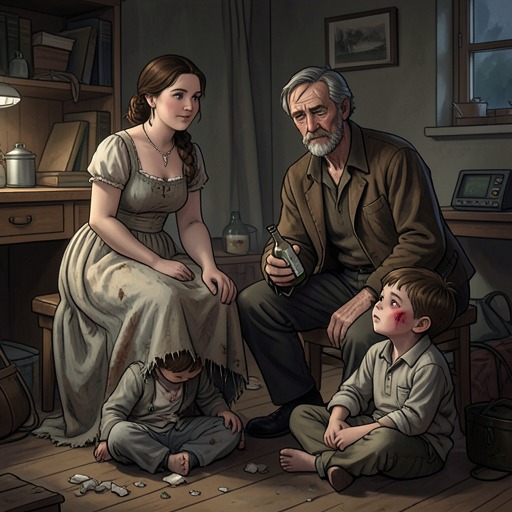
Pecola’s position as a child shapes the stakes of the relationship. In a recollection about girls’ limited access to knowledge and protection, she is described as only about twelve, while adults discuss the violence against her in a way that shifts blame onto the child. The response reveals how little shelter her age and vulnerability afford her. The mother-daughter relationship is therefore not simply a matter of affection or estrangement: it is also a relationship in which the adult responsible for her care does not provide dependable protection.
Care, Discipline, and Silence
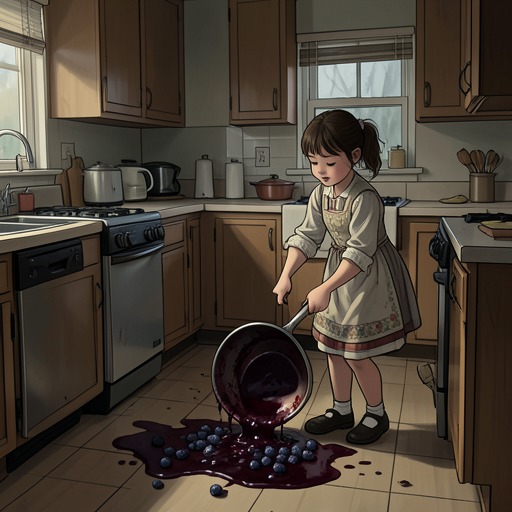
One of the clearest scenes of Pauline’s treatment of Pecola occurs when Pauline enters carrying a tightly packed laundry bag. After juice splashes onto Pecola’s legs and the girl cries out, Pauline rushes toward her and knocks her to the floor with the back of her hand. The act follows immediately upon Pecola’s distress, turning a moment in which the child is hurt and needs attention into another experience of punishment. Its force lies in that reversal: the mother is physically present, but her presence does not function as safety.
The household’s emotional distance appears again in a later imagined exchange about Pecola’s circumstances. The speaker observes that even Pauline does not say anything to Pecola, and wonders whether Pauline sees her at all, since she seems almost to walk right over her. The account connects this neglect to Cholly’s absence, suggesting that Pauline may feel unwell since he is gone; the response does not present that possibility as an explanation that restores the mother’s bond with her daughter. Instead, it emphasizes that Pecola experiences the home as a place where even her mother may fail to acknowledge her.
These scenes establish a pattern rather than a single isolated lapse. Pauline’s physical response to Pecola and her later silence are different forms of failure, but both leave the child without reliable maternal care. The contrast between active punishment and near-invisibility is especially stark: Pecola can be noticed when something has gone wrong, yet remain unseen in the ordinary exchanges through which a child might receive reassurance or recognition.
Harm, Blame, and Public Judgment
The relationship is further shaped by the community’s response to Cholly’s assault on Pecola. When neighbors learn that the person responsible was her father, their conversation combines shock with condemnation of him, but it also turns toward what Pecola supposedly should have done and whether she shares blame. One speaker argues that she should be taken out of school; another says she carries some of the blame, while a reply points out that she is only about twelve. Their discussion makes visible a social failure surrounding the family: the child’s need for protection is displaced by scrutiny of her conduct.
The girls who narrate the events recall Pauline knocking Pecola down and the care she gives instead to a frozen doll that makes a sound like the icebox door. They set that memory beside the expressions of schoolchildren who look at Pecola. The comparison joins household and public rejection without claiming that the two are identical: Pauline’s action belongs to the home, while the children’s gaze belongs to the wider world. In the narrators’ recollection, both become part of the surroundings against which Pecola has had to defend herself.
The account also makes clear that the narrators’ understanding is shaped by hindsight and by the limits of what children could know. They say they may not have remembered every detail but simply knew; their childhood habit had been to treat speech as a code and gestures as material requiring close interpretation. That qualification matters to the portrayal of Pauline and Pecola: the relationship reaches the reader through recollection, inference, and the girls’ effort to understand what adults and children around them have left unsaid.
Contrast and Narrative Significance
An earlier episode offers a striking counterpoint to Pauline’s failure to protect Pecola. After an intimate moment involving Pecola, the three girls lie still together in bed, filled with awe and respect for her; the narrators describe being beside a real person who was ministering to them as something sacred. The scene is not evidence of Pauline’s care, but it demonstrates that Pecola can inspire tenderness and reverence in others. Set against Pauline’s later violence and silence, that brief closeness sharpens what the mother-daughter bond lacks: sustained recognition and a sense of safety.
The novel’s treatment of the relationship also belongs to its wider concern with whose accounts of sexual violence are heard. Its narrative reflection describes the story of female violation as being revealed from the perspective of victims or potential victims—the girls themselves, whom no one had asked. This emphasis on the girls’ vantage point does not turn Pauline into a simple explanation for what happens to Pecola. Rather, it places the mother-daughter relationship within a world where adults and community members fail to make the child’s safety central, and where the children must interpret harm with inadequate protection and incomplete knowledge.
Pauline’s relationship with Pecola thus carries its significance through an unresolved contrast: the daughter is someone capable of inspiring tenderness, yet at home she can be struck, ignored, or treated as scarcely visible. The evidence does not offer reconciliation or a later repair of their bond. What remains is the consequence of a relationship unable to give Pecola dependable shelter, compounded by public responses that question the child instead of centering the adult responsibility to protect her.